Friday, July 30, 2010

Ireland's Best 18 Holes: Hole 3

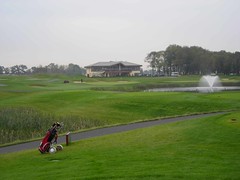
[Photo: The Killeen course's 3rd hole at Killarney]

Now that the Irish Open 2010 is over, it seems fitting to introduce Ireland's best 3rd hole: the par three at Killarney's Killeen course.

I'm not sure how it played during the event, but it is one of the many holes that shows off the beauty of the course and County Kerry. It is nestled up against the lake with a stunning mountain backdrop of the MacGillycuddy's Reeks. You hit across the water to a narrow green, some 166 metres (white tees) away. For the pros it was 183 metres.

[Photo: Tralee's 3rd]

There's no doubt that the hole is made by the setting, and having to carry water is always a difficult affair. There were two other par threes in the running: Tralee with its rocks and sea, its turret behind the green and mountains in the distance is stunning, and vicious on a windy day; Skellig Bay's par three is almost rustic it is so enchantingly Irish - a river runs alongside and in front of the green, with stone walls running up the hills behind.

[Photo: Skellig Bay and the hillsides beyond]


One other 3rd hole deserves a mention: the par four at Concra Wood. A high tee promises a thrilling drive on a hole that doglegs right and almost out into Lake Muckno. Again there are wonderful views.

[Photo: Concra Wood and the right-hand dogleg out to the lake]


Wednesday, July 28, 2010

Ireland's Best 18 Holes: Hole 2

Hole 2 Portsalon Par 4 361 metres. ‘Strand’


Portsalon is one of those ever-changing links that always keeps you guessing. It’s easy to be distracted by the magnificent views of Knockalla Mountain and Lough Swilly, but nothing quite prepares you for the spectacle that arrives as you walk away from the 1st green. The famous Portsalon beach stretches out below you, the views are superb and you’re faced with a hole that is one of the very best – if not the best – in Ireland. It is also Index 3, which demands two immense shots over the beach itself, on the drive, and across the river on the approach. It’s a dogleg that’s all on show below you, so bite off as much as you dare on your drive. It’s a brave shot into the green, just over the river, which is far wider that you’d believe from the tee box.

[Photo: the par five at Tralee. Aim well left]


Tralee and Cairndhu are two of several spectacular alternatives. Tralee’s is the more famous, a par five dogleg wrapping around low cliffs and the beach, heading out onto the headland. As one of the most scenic locations for an Irish golf course, many of Tralee’s holes are outstanding, and this is just one of them. (Apologies for the photograph, which doesn’t do the hole justice at all – checkout the second image at http://traleegolfclub.com/index.php/course/library/).


[Photo: the par three at Cairndhu]

Cairndhu has a peach of a 2nd hole. It’s a par three that comes at the end of one of the steepest opening holes in Ireland. You’re high on a rocky headland and the hole stretches 150 yards from one side to the other. The views, once again, are spectacular – taking in Ailsa Craig and Scotland on a clear day.

One hole I didn’t mention in the book is the 2nd at Old Head of Kinsale. After a straightforward ‘inland’ hole, you arrive at the tee to discover what all the fuss is about. The cliffs, the ocean and a dogleg that dances along the cliffs’ edge.

[Photo: Old Head and the lighthouse]

Sunday, July 25, 2010

Ireland's Best 18 Golf Holes: Hole 1

Hole 1 Scrabo Par 4 404 yards. ‘Giant’s Chair’


Wherever you go there’s a sense of expectation when you walk up to the 1st tee. You want to be amazed and thrilled.

For many, Portstewart ranks as the best opening hole in Ireland. From its high tee, with views along the coast, including Mussenden Temple on the headland, and the density of dunes ahead, it is a breath-taking view. It is a dogleg right.

I prefer the opening hole at Scrabo. It’s a monster that drives from a high tee, straight up to the top of Scrabo Hill and Scrabo Tower. The views are magnificent, the tee shot inspiring and terrifying, and you can see the green waiting for you at the top. You know what you have to do, but it’s an intimidating challenge. And the rugged fairway makes the second shot just as challenging.

Play from the back tee to appreciate full what this hole has to offer, including the razor-sharp gorse. It’s Index 1 and it’s a brutal start that introduces you to one of the toughest inland challenges Ireland has to offer.

[Photo: the par five 1st at Doonbeg]

Other superb opening holes include the par five at Doonbeg, where the green is dwarfed by the dune towering behind it, and Ardglass, where the flank of cannons urge you on your way with the rocky sea shore to your left and the green tucked up and away in a parapet of rocks.

Tuesday, July 20, 2010

Dunmurry Springs

[Photo: the new clubhouse - and a good view of the fescue grasses]

The trials, tribulations and triumphs of Ireland’s new generation of golf clubs continues. That mass of courses built during the late 1990s and early 2000s was always going to be under scrutiny once the pressures of the recession took hold. The Heritage, Moyvalley and New Forest have recently been added to the list of courses in deep trouble, but there are successes too. Concra Wood recently opened its glamorous new clubhouse – to very little fanfare I might add – and Dunmurry Springs has done the same.

When I visited the County Kildare club (www.dunmurrysprings.ie) in early 2008, the club had only been open a couple of years. The clubhouse was a concrete shell and the facilities were located in a stretch of pre-fabs at the back of the parking lot. That said, these facilities were better than some other clubs I visited. But a club can’t operate to its true potential without a clubhouse where golfers can relax before and afterwards.

[Photo: The 3rd green]


The course is well liked by contributors to www.boards.ie and the question ‘has the clubhouse opened yet?’ appeared constantly on threads about it. Now that it has, hopefully more golfers will visit this fine course. It’s a sweet design, by one of my favourite designers (Mel Flanagan), with three tees: two short and one long. I played the short version (white tees 6096 yards) in March 2008, but I plan to go back and play off the back tees later this summer (blue tees: 6757 yards). They are completely different tests of golf, so choose your tees wisely.

They have proper fescue grasses here: if they’re up then getting stuck in the rough will be a nightmare, but if they’re short it’s a relaxing and enjoyable ramble up a gentle hillside (for half a dozen holes or so) with mountain and countryside views for almost the entire round. The club boasts that you can see seven counties from the 6th green. It’s not hard to see why – it feels like you’re looking into Ireland’s soul – and the view from the 15th stretches down to the clubhouse, and the mountains beyond, taking you all the way home.

[Photo: the view from the 15th tee takes in the run of holes back to the clubhouse and the distant mountains beyond]

If you want to find out for yourself, I suggest you get up there for their Open Week, between July 22nd and 26th. And, if you want to go the extra step, you can pay €1,000 which buys full membership and the Annual Sub for the rest of the year. It’s worth noting that the club is just 30 miles from the Red Cow roundabout on the M50.

Green fees vary from €25 to €50, but there are Open Singles events every Thursday for €20, which is a price that’s hard to beat.

[Photo: the par three 11th]

Thursday, July 8, 2010

Go-Kart Review

This is a first: being asked to review a piece of golf equipment. I’m not complaining – it’s a fun project.

The equipment in question is the Go-Kart golf caddy. That was an immediate problem for me because I don’t use a battery-powered trolley but, I know a man who does: my dad. So I gave it to him to use for a few weeks, with the plan that I would give it a go at a later stage. Trying to get it back from him proved harder than I thought as he was rather taken with it. I did get it eventually and used it for our Captain’s Prize. I played well and regard the Go-Kart very fondly as a result.

Probably, of all the equipment we golfers buy – from clubs to clothing – the actual appeal of a trolley is low down the list of priorities. It’s about how practical it is, how easy it is to store and assemble, and how long the battery lasts.
But, in this instance, the Go-Kart looks particularly good. I won’t discuss ‘sleek lines’ and its ‘aerodynamic qualities’ – this is not a car review – but it certainly caught the eye of golfers who I and my father played with. There is a complaint that it looks plastic. That's because it is plastic, which explains why it is so light. But the plastic is very hard and strong – it’s not going to crack or fall to pieces anytime soon. I guess an obvious question to ask is: how long can you expect the trolley to last? A while back I asked a general question on this subject on boards.ie, and got a wide range of answers which indicated trolleys last anything from three to ten years. How Go-Kart compares will only be determined with time.

Dad was highly impressed with the ease of assembly/storage. It takes a couple of goes to figure it out but it’s easy with practice. The battery goes in the middle of the Go-Kart and, again, it takes a few goes to figure out how it works. It snaps into place (there are no wires that need connecting) and you need to watch your fingers which can get pinched during the process. But that’s a clever idea – the no wires bit – it just makes it easier. And it helps not having to bend so far down to put the battery in place - it's another well thought out piece of design. It should also be noted that the battery is an integral part of the frame, and without it the Go-Kart can’t be assembled properly.

On the course, its lightweight frame makes it easy to control and turn, its wider wheel base gives it more balance (important on the front 9 at Greystones), and its speed is easy to adjust. It also has an on/off switch which means you can click it off to play a shot (thus saving power) and then switch it on and resume at the same pace you were going at previously. A nice touch which means less fiddling with the speed control dial common to many trolleys.

And should the battery fail, it is still easy (and light enough) to use as a regular push trolley.

Storage is excellent and wheels can be removed and replaced with a simple press of a button, should you feel the need to do so.

It's a great piece of kit that comes in six colours. The plastic might not have the kudos of the metal that is typical of competitor products, but it does give the Go-Kart specific advantages in terms of weight and storage. Once you get the hang of assembling it and getting the battery in place you’ll find it does everything you need it to do. It also takes batteries from some competitor models.

I liked it enough to keep it, but dad has taken it back and won’t let me near it. Price is 260 euro (295 for the version with a more powerful battery and 225 with no battery at all). Delivery is 25 euro on top.

A very useful FAQ section can be found here: http://www.gokart.ie/the-go-kart/faq/ and the feedback I’ve heard on customer service is excellent.

And if Taylormade, Titleist, Ping... want to send me some clubs for review, I'm here for you.

Friday, July 2, 2010

www.boards.ie vs. Castleknock

[Photo: Castleknock 18th, with double green for the 9th. Both par threes]

Here's another tip for golf clubs around Ireland - after my one about mobile phone chargers. Take a few minutes and sign up to the very popular golf forum on http://www.boards.ie/.

You don't have to contribute, but you can keep an eye on what Irish golfers are saying are about anything from comments on new drivers to debates on rules. More importantly, you can see what's being said about your club. Recently, two clubs were getting some stick - Elm Park and Castleknock - for very different reasons. Elm Park was being bashed for its elitism, whereas Castleknock was being abused for the poor quality of its prizes in its weekly opens, as well as the price of the opens.

I don't think a 30 euro entry fee is that bad, but it would seem that there are plenty who do. When compared with other courses I can see their point, but Castleknock considers itself one of Dublin's top parklands, so a premium might be expected.

The prize won by the open comp winner was the chance to pick something from the '45% off' rack in the pro shop. That's not what I call a prize, and there are many others who agree with me. As a result, the feedback is all negative - even from those saying they like the course. The manager of the club has contacted me subsequently to say that many of the emails were inaccurate, but he didn't say how and he didn't go on to the forum to post a response.

Mount Juliet have cottoned on to the forum and replied to some queries about the price and availability of food at the club. As a result, they got eight golfers eating in the clubhouse bar who might otherwise have gone elsewhere.

So, whether you want to be seen contributing, or whether you want to skulk in the wings and see who's saying what about you, every Irish club she be on the forum. It's the only one that really counts.

Tuesday, June 29, 2010

Foot Fault


When you consider how long you spend on your feet, playing a round of golf, you’ll appreciate the importance of good footwear. There are plenty of golfers out there who spend a minute or two trying on shoes, walking around the pro/golf shop, mimicking a swing or two, and then handing over the cash. And sometimes it’s up around the €120 mark, so you think folks would take more care when buying a shoe that is going to take one hell of a beating on the golf course.

At Ballybunion, Ronan played the last hole of the night (our 27th) in bare feet because the back of his heel was rubbed raw by a pair of old shoes that had worn through at the heel. That’s how much of a beating you give your shoes.
Am I offering advice about shoes? Not at all. I've digressed entitrely - but I will draw your attention to a more specific aspect of your footwear: orthotics. Or-what you might ask, or perhaps you know exactly what I’m talking about.

Essentially, orthotics fit inside your shoes and help your gait and the position of your feet relative to your body. They can be for flat feet, high arches or other foot ailments; they can be for knee and back pain too, because the pressure put on your back and knee by a poor footstep can be immense. Remember Olazabal’s foot problems? He had them for several years before they realised it was a back problem manifesting itself in his feet. And then he won the Masters.
I visited a chiropodist today who specialises in orthotics (I’ve used them for 15 years), and after walking barefoot across a special mat with hundreds of sensors he pulled up the graphics on the PC screen and showed me how I walked.

In a comparison that many golfers will be familiar with (namely, when you’re videoed during a lesson and then shown your swing compared with Tiger Woods – is there anything more depressing!), I got to see the progress of my footstep compared with a “normal” footstep. The two looked like they came from different species. You’re supposed to walk on every part of your foot, from heel through to toe, yet I land on my heel, miss out the centre, progress to the front foot and then completely ignore my toes.

It made me feel like an uncoordinated ape! But it got worse. When you put your foot down, your heel is the only part of your foot striking the ground for the first 20% of your footfall. That’s the “normal” footfall anyway. My right heel comes in at 46%; my left at 57% - meaning my balance is somewhat askew. I could go on with the figures, but I feel so abnormal at this point that I’d chop off my feet if I did.

I got measured for new orthotics and that was that, but walking down the street afterwards was an entertaining experience as I tried to walk like a “normal” person and ended up doing a Charlie Chaplin. So, if you have back, knee or ankle pain, or even tight shoulders, it may be your body’s way of telling you that you’re not walking as well as you should. Orthotics could be the answer.

Thursday, June 24, 2010

Adare

Here’s a little piece of customer service that golf clubs might like to take on board: get some mobile phone rechargers. It shouldn’t cost them a cent as you get a free charger every time you buy a phone, which means the average household has 23 chargers shut away in drawers and boxes. Ask your members if they have a spare one they don’t need, and then keep the rechargers from the different manufacturers in a box, ready to say to a member or visitor with a dead phone – “here, we’ll plug that in and recharge it for you, and you can come and get it in 20 minutes/after your round.”

[Photo: the par four 3rd at Adare]

[No doubt someone will quibble that there is no place for mobile phones in a golf club – but if you think you can stop their use, I have two words for you: King Cnut.]

When we arrived at Adare for our second round of the trip, the first request made in the pro shop was for a mobile phone recharger. One was produced immediately. Nice touch – keep the customer happy. Rod and I were delighted – yer man, Ronan, had been using our phones since the previous day.

Adare was preparing for the JP McManus Pro-Am (5 & 6 July) and a huge marquee was being erected near the clubhouse. The place looked superb and as there was no surly security guard this time, I started in much better spirits than my last visit (rain, puncture, obstructive guard). A great breakfast (highly recommended) and a leisurely wander around the pro shop were just what we needed, and the young lad in the shop told me that 12 of the world’s top 15 players were playing in the event (no Mickelson, Kim or Stricker). The confirmation, three days before, that Tiger was playing had boosted interest hugely, so I wasn’t that surprised to hear they had a full time sheet.

[Photo: the approach to 18th green, over the River Maigue, with a glimpse of the hotel]

Adare is one of those grand venues, with a long drive up to an elegant clubhouse (not to mention the 19th century hotel and former residence of the Earl of Dunraven), excellent facilities and a relaxed air that matches Mount Juliet. It puts you in a great mood. I’d also wanted to play Adare rather than another links course so that we could savour the differences between a top links and the best parkland in the country. It started well, too, as three drives found the fairway, but after that balls ended up in the water a bit too often.

We played skins, 20c a skin, and I had eight skins after eight. After that, nothing could ruin my day. Ronan, as is his way, had a late surge that pulled in two birdies and a back 9 of two over. The second birdie came on the famous 18th where he was able to have a go for the green in two, over the River Maigue. 511 yards with all carry to the green makes for two fine blows. Rod’s golf was up and down, literally, as he dug his way out of the rough and bunkers to make several elegant pars.

[Photo: the River Maigue runs peacefully across the par three 11th]

In ‘Hooked’ I made two observations about Adare that I should revisit. The first comment was that the bunkers are too firm. When I read my review before this trip I thought I had made a harsh judgement, but the bunkers are hard. There is a fine layer of soft sand on top and then firmness underneath that can bounce the club. On this visit there was no rain to soak the soft sand and playing out of the bunkers was a pleasure – you get more check. This is the way Adare likes its bunkers, evidently, and that’s fine with me.
My second comment was that Adare was tough. If you play badly, almost any course is tough, but I remember Adare having much tighter fairways and trees that squeeze you a lot more (at the start and on the back 9). This time I was playing some of the best golf I’ve ever played and realised that sensible placing of the ball makes all the difference – yes, I know, that’s true of any course, but with trees and water crowding your line it’s not as obvious at Adare, where you are tempted to force it.
[Photo: the looping par five 7th, with water threatening on all shots]

It is big and spacious; the design and routing flow easily and, apart from one open stretch (holes 5 to 8), there is a denseness that makes the holes solitary and beautiful.

Up for debate
There is a considerable debate about the best parkland in Ireland. K Club, Mount Juliet and Adare are usually mentioned, alongside Druid’s Glen, Fota Island and Slieve Russell. Then there are the new pretenders: Concra Wood, Killeen Castle and Lough Erne. The oldest of them all is Carlow, so there is plenty of choice. I put three courses at the top of my list: Mount Juliet for hospitality, Druid’s Glen for dynamism, and Adare for scale and beauty. I suspect that Concra Wood and Lough Erne will be challenging that top three very soon, but for now I’m content to say that I played the best parkland in Ireland last week, and one of my top three favourite links (Ballybunion).

[Photo: downhill approach to the dogleg, par four 13th]

Not bad going when you consider that Ballybunion was free (a fourball voucher), Adare was 50 euro a head (thanks to the lovely Orla), the accommodation was free and Ronan refused to accept any petrol money – so just food, drink and crisps (not strictly a ‘food’ group). And poker money of course.
The only negative is the size of the changing rooms, which are too cramped and dark after the expansiveness you get to enjoy everywhere else. But seriously, after a course this good, who cares!