Tuesday, August 12, 2008

Craddockstown – attacked

OK, so maybe ‘attacked’ is an exaggeration, but I was certainly intimidated. I had just teed off over the big pond on the 5th when three ducks swam in my direction, climbed out and headed straight for me. I swear they had a look in their eyes, and my drive hadn’t gone anywhere near them. They came to about five feet, shook their heads, shook their tails, expressed their displeasure and then dismissed me. As I made a hasty getaway I passed the yellow society tee which sits in the water. About 40 ducks watched me pass. It was all far too quiet and I fled. Back in the clubhouse, I heard someone informing their group that they were playing off the yellow tees. I nearly voiced my concerns but realised they’d think I was mad.

After Padraig’s brilliance in America, it was enough to inspire some brilliant golf – ducks aside. Have you ever found that? When you watch the best it seems to affect you mentally. Maybe you slow down and keep your head still. Anyway, it worked for me at Craddockstown and I went around in good time, dunking just one ball in the water at the very difficult, but short 10th. If you get around this newish parkland track without dumpling a ball in the water (ponds and streams – some hidden) you’ve done very well indeed.

[Photo: Approach to Par 4 10th]

It was the day after some seriously heavy rain that flooded parts of Dublin and Kildare, but the drainage here had done a terrific job. Only the bunkers looked obliterated, with those tell-tale tracks drifting down through the sand. Water remained in many of them, but clearly it had gone down. When I reached the par three 15th, there were two very nice balls (one a ProVI) clearly in view under water in the bunker. After that I kept checking every bunker – quite a task as Craddockstown likes its bunkers.


[Photo: Par 4 13th]

Thursday, August 7, 2008

Cairndhu Rocks

[The par three 2nd sits on top of the headland]

I always love it when a golf experience begins before you arrive. The drive along the Antrim coastline puts you right on top of the sea, and if you’re coming from Larne then the golf course appears on the headland in the distance. You’re reaction is: “no, it can’t be!” But it is. Those are golf holes up there. In fact that’s 1, 4 and 5 you can see. The best of all, the par three 2nd, is at the very top where you can’t see – but when you get up there you’ll want to have your camera with you.

For many, a buggy might be the order of the day. In the pro shop, the elderly gentleman in front of me asked for a buggy for 9. Brian, behind the counter, shook his head: ‘you won’t fit 9 in a buggy,’ he quipped.

Cairndhu boasts the best views in Ireland. Having played nearly all of its 350 golf courses I would dispute that, but that doesn’t mean you won’t love them and won’t be overwhelmed by them. Indeed, you’ll need to stop a couple of times on the way up 1 (and 3) just to appreciate them – and catch your breath. It's also worth noting that their driving range must offer the most awe-inspiring drives - see photo.

It is a spectacular start, and even when you get onto the ‘regular’ parkland holes on the back 9, the views just keep cropping up. For me, one of the highlights is Ailsa Craig, rising over 1,000 feet dome-like off the Scottish coast. It rose to ever greater heights of fame back in 1992, when the Scottish Women’s Curling Team won the curling gold medal at the Winter 2002 Olympics, using curling stones honed from Ailsa Craig rock. Sadly, on Cairndhu’s 18th, called Ailsa, the trees have grown up so high behind the hole that Ailsa Craig is barely visible. Then again, there’s more than enough to see, and the golf is excellent.

[The approach to the very difficult par four 15th. This approach is blind]

One final point: as I drove along the road a big brown sign appeared for Carnfunnock Country Park. On the sign was a golf flag, so up the road I went only to be stopped by a barrier. No, this was not the place, and the girl in the small booth said that a lot of visiting golfers get it wrong. So keep going for another few hundred yards until you find a sign that says ‘Cairndhu Golf Club’.

Holywood - beware the nuns

[Photo: the Rory McIlroy wall of fame]

In the Holywood bar I thought I had become very popular. I was sitting at a small table, typing up my review for Royal Belfast, when a group of people came towards me. Not surprisingly, I wasn’t the attraction and they didn’t give me a second glance. I was sitting under the Rory McIlroy wall of fame. His scorecards from the 2007 British Open were on the wall with a signed flag from the 18th. Other pictures adorned the wall along with cards showing course records he had broken at Clandeboye in June 07 – a seven under par 64 – and at Royal Portrush in July 05 – an astounding 11 under par 61, including 5 consecutive birdies to finish.

I then encountered Susie, a Slovakian blonde (and yes, every bit as gorgeous as that sounds) who had been working in the Clandeboye bar the night before. The same catering company looks after both golf clubs. We chatted briefly and Rory McIlroy got mentioned. She laughed and told me that Rory’s dad was her boss and it was he who I had paid for my dinner the previous night. I discovered later that Rory had been in Holywood that afternoon and had been sitting next door in the members’ bar.

As I walked towards the 6th hole, a delicious drop shot of a par three that sits completely separately over the lane, I was stopped dead in my tracks by a sign just before the road. Have a look at the pic and see how gloriously ambiguous it is.

Nuns Walk is the name of the lane and the hole, but it all depends on how you read it. There’s even an identical sign on the way back, crossing over to 7.

Holywood is hilly, and while the start is slow (no climbs involved), it’s not until you start climbing from the 8th green that you sense something big is coming. When you get to the 10th green you will encounter a strong run of holes that have the best views and make Holywood worthwhile.
[Photo: the par 4 14th. The best hole and somewhat different to the rest]


Like Royal Belfast, some directions would really help. As Rory’s home course there are going to be many golfers in the years ahead who will want to come here.

Tuesday, August 5, 2008

Royal Belfast – old and distinguished

[Approach to the par five 5th]

It was not easy to find Royal Belfast. Sometimes clubs seem to forget that signs are necessary to make things easier for visitors. After you pass the Ulster Folk Museum, heading from Belfast, take a left turn at the first set of traffic lights down Station Road.

[Photo: gloriously wild par three 11th – the rest of the course is far more manicured]

The clubhouse dates back to 1859, and it makes for an impressive arrival as you drive alongside the 18th. In the original part of the building (an extension has been added) you’ll find the bar with black and white photographs of ships adorning the walls. Overlooking Belfast Lough, as Royal Belfast does, it seems very fitting. Actually, the course gets right down to the water and three holes almost get wet.

If you’re wondering how old the course is, there’s a small white arrow pointing you to the 5th tee, at the back of the 4th green. It has been there so long that the tree that it is attached to has now started to grow over it. See pic below.


As I returned to the clubhouse the early morning starters were arriving. I watched one young man climb out of his car and I realised there are some things I don’t do. I don’t do pink jumpers, and I don’t do jumpers thrown over my shoulders like a cape. This fellow managed to combine the two, with some aplomb I might add. But the brown shoes were just screaming for help.

[Photo: par three 7th]

Monday, August 4, 2008

Clandeboye – George Bush has left the building

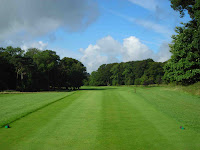
[Photo: Dufferin course par 4 7th]

Clandeboye was another of the courses (18 hole Duffering and 18 hole Ava) that I had eagerly waited to play. About 10 years ago I worked for Esat Digifone, and in my marketing role I dealt with Johnny Packham, a Northern Irish gentleman, who runs Open Fairways (www.openfairways.com) - check it out if you don’t know that it’s one of the great ways to play golf in this country. He was a member at Clandeboye and he had been very enthusiastic about the course. Unfortunately, he couldn’t make it when I was due to play, but he sent a very able deputy – Shane Darby.

Now Shane is what you call one of the lucky Irish. He comes back from Oz and he decides he wants a career in golf – his passion. He saw his five years of promoting forklifts (in Ireland and Oz) as not being in anyway a problem, and he fired off an email to Open Fairways. And what do you know, one of the guys at Open Fairways had just handed in his notice and Shane fit the bill perfectly. Who says you can’t your dream job. He’s living proof. Mind you, so am I.

[Photo: Shane checks out the lie of the land of the short par 4 9th on the Ava course]

When I arrived in the evening it was tipping down. The visitors’ car park is a little bit away from the clubhouse and I ended up staying in the camper for over an hour, waiting for the rain to ease off. When I finally got up there the putting green was slowly sinking under water – see pic. It didn’t bode well. I half expected Shane to phone and say he was declining the opportunity.

The next morning was the complete opposite – as we’ve come to expect of Irish weather – and Shane appeared at 7.30 as agreed. He’d only played a handful of times this year and here he was, about to play 36 holes, and he was carrying his clubs. On top of that he’d strained his hamstring the night before during rugby training. I was trying to figure out how I was going to carry him from the furthest reaches of the course when the time came, but as the day progressed he loosened up and had no problem getting around.

[Dufferin course, Index 1, par 4 4th green]

We played the big course first – the Dufferin – in an open singles competition. It had been a while since I had played in one and it always focuses the mind. We both ooh-ed and aah-ed as we went around, loving what the course had to offer. We even got to see two huge buzzards that are nesting somewhere off the 5th fairway. This is a seriously beautiful golf course that combines heathland at the top with mature parkland at the bottom. And a combination of the two in between. You have got to come and play here before Clandeboye realises that the green fees they’re asking are outrageously good value. There are plenty of great value courses up here – Donaghadee and Down Royal spring to mind – but (and no offence to these two) the Dufferin course is in the top tier of parkland courses.
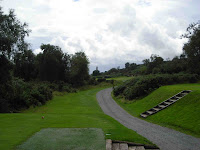
[Photo: Ava course par three 6th all well hidden]

And as for the clubhouse… huge and plush. Put it this way, how many golf club locker rooms have a sofa seating area, with TV, overlooking the course? There’s only one problem to all this: it is very easy to get lost. No really. At any one time you have about four doors to choose from. As we were leaving the bar after lunch, Shane did a classic George W Bush: he opened a door on the way outside and walked straight into a closet. Oh how we laughed. At the end of the second round on the Ava course, Shane went to walk into the pro shop and went into the buggy storeroom instead. Add to that my very circuitous (and torturous) routes to get to the bar – on several occasions – and my advice is to look for direction signs. Or just ask.

After a very slow start, Shane hit the shot of the round, almost claiming a hole in one on the 14th. The ball finished just a few inches behind the hole. Mind you, his approach to 18 on the Ava course was even better because he said he was going to hit it to a foot, and he did. I tried it and ended up in the bunker.

[Photo: Ava course par four 17th. Yes, exactly what you see from the tee]

Ava is what you call a quirky course. It is short, and with so much gorse running away off the tee some holes are madness. A driver would be foolish on most of the long holes. Even on the par five 8th a driver could be foolish. The course is simply too tight and often too blind. The 17th is crazy. Stand on the tee and you have no idea where to go. Seriously, no idea at all. And 13 is not dissimilar. At the same time, it’s a lot of fun and the appeal of the course is huge with that lovely rich heathland feel.

I was told before I arrived that I should play the Dufferin course first. Having played both, I suggest that you play Ava first – it will give you a taste of the greens, and it will sharpen your game for the main event – because the Dufferin course is most definitely the main event.

Enjoy.

Sunday, August 3, 2008

Carnalea and Blackwood

I laughed out loud when I arrived at Carnalea clubhouse. I walked into the bar and there, hanging from the ceiling, was a glitterball. Having been highly amused by the glitterball in Donaghadee, here was another one 24 hours later. Big disco folk up here, evidently.

Carnalea is another seaside course just outside Bangor. And it was another morning of heavy rain. The course is split in two by a busy railway line and it divides the course quite conveniently. The sea side has corrugated roof effect fairways and that spartan pine tree cover that gives it a dark feeling. The water is never far away and you get down and close to it after 6, one of those quirky holes that you’ll love or hate. Up above it’s a more regular parkland affair with greater variety to trees.

The course reminded me of Greystones because it’s the first club (out of 310) that I’ve been to that is a par 69, with two par 5s, five par 3s, and two quite different 9s. But that’s where the similarity ends.

The greens were in reasonable condition and it highlights something I don’t put in my course reviews if I can help it – the quality of a course. Carnalea’s greens were looking just a bit patchy, but it’s easy to see that their quality is good and I just happened to see them at a bad time. If I’d come a month ago I might be raving about them. And since the book is not out for another 6 to 9 months, how is it possible to accurately reflect the state of the greens? Or the fairways for that matter?

There is a very rich history here as the club is tied up with Royal Belfast (I’m due there in a couple of days), the oldest club in Ireland which dates back to 1881. In the early days the clubs seemed to pass Pat Sawey, the local pro, back and forth. Even after he retired he continued to coach at Carnalea. He died at the ripe old age of 89 and his ashes interred in the trees on the right of the green on hole 18 – which had long been named “Pat’s Way Home”, after the professional.

There is new blood at Carnalea now. Her name is Sarah Louise Winter, and she plays off 3. She’s 16 and has already represented Ireland Under 16s and Ulster Under 19s. There is so much talk about the remarkable Maguire twins that there’s no doubt Irish women will soon rise to the top of the game. Carnalea are rightly proud of Sarah Louise, and her photograph appears on several walls in the clubhouse. The photo alongside was taken by Ken Best.

One final comment – the clubhouse and changing rooms are separate – and as comfortable as the bar is, a bit of attention to the changing rooms wouldn’t go amiss.

Then it was off to Blackwood, a rather odd affair that has a stunningly wide area to lay a golf course, with great woods all around. You get to walk through a few of them to reach tees and it feels comfortably rustic. The emphasis seems to be more on the driving range and the 9 hole par three course (excellent condition by the way) and the clubhouse is certainly different. It would help for starters if there were signs pointing to the 1st tee – it’s quite a hike.

You start to notice things when you spend all your time playing golf courses – and one of the big ones is scorecards. Some have a map of the holes (not all of them legible), some don’t, some give you local rules, and most tell you whether the distance markers are to the middle or the front. Carnalea and Blackwood both miss out on that one – so be sure to ask. At Blackwood, several of the greens sit right under trees/woods, so not knowing your distances can be problematic.

Saturday, August 2, 2008

Donaghadee, by the sea

Donaghadee was easy to find – after some of my recent ‘hidden’ courses it was a relief to drive straight in and park. As with most places I have a quick look around, and stretches of the course were on show in the evening sun. A good feeling, and the course was busy – always a good sign, even at 8 in the evening. Knowing that rain was coming the next day I was sorely tempted to go out, but another 54 would have done me in, and I would have had to fly around. So dinner and a pint seemed much more appealing. And they were. The food really is good here and the whole entertainment thing is taken seriously – bands and dinner dances are frequent events – you’ll find a programme of events around the clubhouse.

Two things made me laugh when I arrived in the bar. The first was a large glitterball hanging over the dance floor. I haven’t seen one of those since the days when ‘clubs’ were called ‘discos’, and the obligatory slow set sent spotty teenage boys into a frenzy of uncontrollable hormones – at least until Lady in Red made us all violently in. My brother-in-law went to a wedding ten years ago when the bride walked down the aisle to Lady in Red. One side of the aisle (the bride’s, presumably) were all sobbing because it was so beautiful; the other side were wetting themselves with laughter because, and let’s be honest here, it’s naff.

The second thing in the bar was the wooden marker for the 13th tee box. Not often you see one of those in the bar, and certainly one of the toughest driving holes I’ve ever seen. The club is looking for sponsors and the tee markers will add tremendously to the appearance of tee boxes. And what better place to promote the idea than in the bar.

Then the rain started at 3am and it was still going at 8am. So I decided to walk the course. Playing in those conditions doesn’t give you a feel for a course at all.

Donaghadee is a good seaside course. I liked it, even only walking. There’s definitely a lack of colour but it does combine links, parkland and heathland so there’s something for everyone. And this close to the sea it’s always hard work getting deciduous trees to grow. I had a long chat in the bar afterwards with Jim, the Manager. For once I actually felt like I had something to offer, but only because the comments I was making were already being addressed. The most notable of which was on 16, where a long tee box hides the beauty of the downhill drive when playing from the back tee. The new course layout shows it being ‘stepped’. There were other things too, but when I mentioned bunkering, Jim immediately said that this was all going to change. Which is a shame because I thought some of the bunkering was brilliant.

The course is worth a visit undoubtedly – the green fees alone are a steal – and you have, in holes 2 and 12, those magnificent high tees that drop down to a distant fairway before rising up high to the green. Great to look at and nerve-wracking to play.

Friday, August 1, 2008

Shandon Park Spitfire and the adventure of Knock

Four very elderly people were sitting at the table behind me in Shandon Park’s clubhouse. I never like listening in, but every now and again you can’t help but overhear. At the start they were talking about great grandchildren. One of them had six of them and photographs were passed around. But it was a conversation later on that made me realise something both amazing and sad. Very soon there will be no WWII veterans left, and the memories that these remarkable men and women carry around with them will become history.

The man with six great grand kids started talking about the time a spitfire was grounded and what he and his comrades had to do to get it ready for action again. I missed much of it, but I heard reference to approaching German tanks, scalding hot metal and Tobruk, in Libya.

Why read it in a book when you can hear it from people who were there.

Shandon Park was an early morning outing that started in the rain. Even on a damp, grey day the pleasure of Shandon Park shone through. Tucked away in the suburbs it is green and flat and cosy. No, wait, scratch that. It starts out as flat, and from the 1st tee and clubhouse that’s all you see, but once you head up 2 and then down and across 3 you realise it’s anything but. It’s clever deception but it’s all fun, and mostly straight. 14 is the hole you have to be wary of off the tee as it is the only blind shot. It’s index 4 and it curls right, around the trees, to a slightly raised green. I birdied it of course. It’s always easy when you can chip in from 30 yards.

Good facilities and good food too.

I had only just arrived at Knock that afternoon – having driven by Stormont, which was a moment in itself – when there was a knock on the window. Here’s trouble, I thought, but it was Robin, the Hon Sec, and we headed inside for a quick drink. The first thing he told me was that back in the early 1900s, Knock used to be a 9 hole course playing at Shandon Park. Small world.

After that we went in to the pro shop and Ricky (the pro) asked a few of the usual questions. Then he threw Waterford at me. What, I asked. I like Waterford, he said. You mean the golf club, I asked, thinking he must be mad. That’s exactly what he meant, and I’m in no position to question him when I like Scrabo and seem to be the only one who does – quite literally. When I said it to Ricky, he blanched.

Knock is another course that surprises after an unimpressive entrance – immediately off the busy A20. It is extremely tight in places, generous in others, always entertaining but with greens that don’t excite. They’re fine as putting surfaces but, as an example, take the 6th – a beautiful drive with huge trees down the right. The fairway bumps a bit, hops over a rocky stream and runs to the green in a tidy little corner of the course. But for your second (or third depending on your abilities – it’s a long hole) the green lies flat. It’s something that crops up at many courses and I know you can’t click your fingers and find thirty grand per green to make it sit up and look inspiring. And on some courses (Down Royal for instance) flat ‘on-the-land’ greens work best. So, for the purposes of my book, I want people to know that after good drives your approaches are a little less inspiring. It doesn’t mean I don’t like the course, because I do – I think Knock has plenty of energy to keep you thoroughly entertained.

And speaking of the 6th. I was standing on the 7th tee as a fourball came up 6. One of them hit his shot wide and it bounced up onto the tee box, not far from me. I had played off the proper yellow tee, as suggested by Robin, and not the yellow markers of the day which were further forward (and well out of range of errant shots). As the man approached he gave out to me, pointing out that there was a very good reason why the tees were forward. Hmm, evidently! When I told him that the Hon Sec had recommended that I play off those tees you could see the light going on. “Are you the guy writing the book?” And then he was as nice as pie. Now, as amusing as the switch in moods was, I congratulate him for making the comment. All too often we go about muttering under our breath because someone is too slow or someone is rude. I’ve been keeping it in for a number of years and it’s made me bitter and twisted. Scratch that. More bitter and twisted.